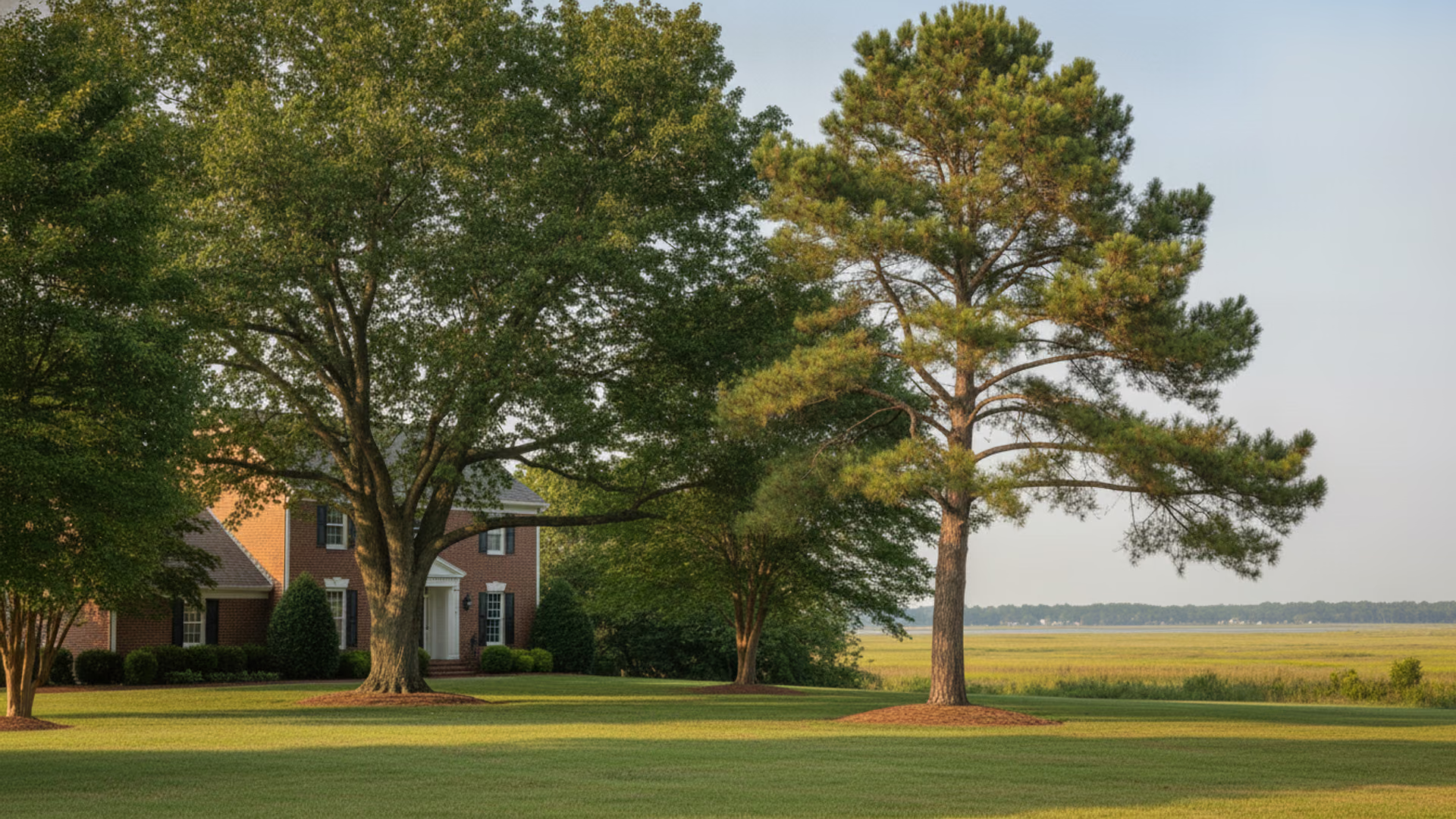
The willow oak that sold you on the house has quietly turned into a problem: branches touching the roof, gutters packed with twigs after every front, a dead pine limb over the driveway you check every time you pull in. That's usually the point where a homeowner starts searching for tree trimming in Yorktown, VA — and it's work Cut 'Em Down Tree Service has been doing across York County and the Virginia Peninsula since 2006. We trim and prune mature shade oaks, loblolly pines and ornamentals like crape myrtle as part of complete tree care across Hampton Roads. Every job is done by our own crews, bonded and insured, and every one starts with a free written estimate that says which cuts each tree needs and which it doesn't.
Signs Your Trees Are Overdue for a Trim
Trees don't announce that they need work; they hint. Most trimming calls start with one of these:
- Branches touching the roof. Limbs on the shingles scrub off granules every time the wind moves, pack the gutters with leaves and pine needles, and give squirrels a bridge onto the attic. They're also the first thing a tropical-storm gust turns into a roof puncture.
- You can't see out the window. A porch in permanent shade or a kitchen dark at noon means a crown that has never been raised or thinned — not a tree that has to go.
- Tree limbs over power lines. A limb touching or within reach of the line to your house or the line along the street is a Dominion Energy call first, never a homeowner with a pole saw. More on that below.
- Deadwood dropping on the driveway or patio. Bare limbs against a full summer crown are already dead, and thunderstorm downbursts take those first.
- A neighbor's limbs over your fence. Handle it cleanly and early (see the FAQ) rather than argue about it later.
One honest boundary: a new lean, cracked or mounded soil at the base, or mushrooms at the root flare is not a trimming problem. If you're not sure whether a tree needs a trim or has something bigger going on, start with a tree health assessment so you pay for the right service.
Types of Pruning We Do (and the One Cut We Refuse)
Trimming isn't one cut repeated fifty times. Each tree gets a plan built from a few core techniques:
- Crown thinning — selective interior cuts so wind and light pass through. Less sail area means less load on every limb when a nor'easter or tropical system hits.
- Crown raising — lifting low canopy off roofs, driveways, walks and sight lines. This is the can't-see-out-the-window fix.
- Crown reduction — bringing height or spread down with drop-crotch cuts back to a lateral limb at least a third the diameter of the stem removed. That lateral takes over, the wound seals, and the tree regrows from real structure.
- Structural pruning — training young trees to one dominant leader with well-spaced scaffold limbs. Builder-planted maples, oaks and crape myrtles in the 1990s and 2000s subdivisions are at exactly the age where today's double leader becomes tomorrow's split trunk.
- Clearance trimming and deadwooding — roof, gutter, driveway and view clearance, plus dead limbs out of the crown, roped down in pieces over anything that matters.
We do not top trees. Topping — hat-racking a crown back to bare stubs — leaves wounds the tree can't seal, invites decay, and forces a thicket of fast, weakly attached water sprouts that leave the tree taller, heavier and more likely to fail in the next storm. Crown reduction is the professional alternative and the only one we offer. The annual "crape murder" you see across the Peninsula every February — crape myrtles chainsawed to knee-high stubs — is topping too, on a tree that only needed light work.
Storm-Ready Pruning Before Hurricane Season
Atlantic hurricane season runs June 1 through November 30 and peaks August through October. The Peninsula's defining tree event is still Hurricane Isabel on September 18, 2003 — thousands of trees down on saturated ground, 1.8 million Dominion customers out, 92 percent of Dominion's Virginia customers without power.
Pruning does three real things before a storm: it removes the deadwood and overextended limbs that fail first, thins dense crowns so gusts pass through instead of loading the tree like a sail, and gets weight off the roof line and the service drop. What it can't do is anchor a tree. A shallow-rooted loblolly in wet Slagle or Emporia soil can go over whole with a perfect crown — that's a root-plate question for a tree health assessment, and sometimes tree removal is the safer call. We'll tell you which at the estimate.
On lines: Dominion says trees and limbs are the number one cause of outages on its system, and the August 2026 storms left more than 4,000 York County customers dark — one "Tree On Line" outage alone took out 2,636 customers on August 19. Dominion trims roughly 20 feet above and 15 feet beside its distribution lines on a 3-to-5-year cycle, but it clears brush only. Larger limbs, the trunk, and every tree outside the right-of-way — the ones that actually fall — belong to the homeowner. If a limb is touching or within reach of a line, call Dominion first at 866-366-4357. Once the utility has made it safe, we handle the rest of the tree. Our full checklist for getting trees ready before June 1 is in our hurricane-season prep guide.
How Often Should Trees Be Trimmed — and When?
How often should trees be trimmed depends on what's growing. Mature shade oaks and pines want a professional look every 3 to 5 years. Fast, weak-wooded growers — sweetgum, red maple, Bradford pear — and crape myrtles need lighter, more frequent work. Young trees benefit from structural pruning every 2 to 3 years for their first decade, which is the cheapest tree work you will ever buy.
As for when: the dormant season, roughly December through early March in our mild zone-8a winters, is ideal for oaks and other hardwoods. Structure is visible without leaves, cuts seal as spring growth starts, pest and disease pressure is at its lowest, and firm ground protects the lawn. The exceptions matter: deadwood and hazard limbs come off any time of year, crape myrtles are pruned in late winter, spring bloomers like dogwood and redbud go right after they flower, and storm-prep clearance should be finished before June 1 — not scheduled in September with a named storm on the map. The month-by-month version is in the hurricane prep guide.
Peninsula Trees, Yorktown Yards
Crape myrtle is the Peninsula's signature ornamental and its most abused tree. Proper pruning removes suckers, crossing branches, pencil-thin twigs and spent seed heads and keeps the natural vase shape — no knee-high stubs.
Live oak and willow oak are the shade trees people build yards around; the Peninsula's 150-to-200-year-old Emancipation Oak spreads about 100 feet. Heavy laterals over a roof want gradual end-weight reduction with drop-crotch cuts, done dormant. An oak whose leaves brown at the margins in late summer may have bacterial leaf scorch, which pruning won't fix — that's an assessment call.
Loblolly pine dominates the 1960s–90s subdivisions. Pines get deadwooding and lower-limb raising, never aggressive thinning of an already sparse crown, and a storm-snapped top comes off cleanly before it invites Ips and black turpentine beetles.
Old-canopy lots in Historic Yorktown (median build year 1948) and Edgehill (1961) put sixty-plus-year-old oaks, pines and pecans over aging roofs, septic fields and narrow drives — rigged limb by limb, never free-dropped.
HOA and waterfront lots. York County lists 91 homeowner associations; Kiln Creek's architectural review board governs exterior and landscape changes, and Coventry, Running Man, Tabb Lakes and Marlbank Cove all run architectural review. Routine pruning rarely needs approval the way a removal does, but check your covenants — our written estimate describes the work so you have something to hand your board. On tidal lots along Dandy, Wormley Creek and Chisman Creek, the Chesapeake Bay Act's 100-foot Resource Protection Area buffer restricts removals; pruning is generally fine, and we'll flag it if your lot is in the buffer. All of it is everyday tree work in Yorktown and York County.
What a Trimming Visit Looks Like
It starts with a free on-site estimate. We walk the property with you, look at every tree on your list, and identify which cuts each one actually needs — and which it doesn't. Sometimes the right answer is to leave that one alone this year. You get a written estimate before any saw starts.
On the work day, a trained, experienced crew makes the cuts. Limbs over roofs, fences, pools and gardens are roped and lowered under control, and every cut lands at the branch collar — no flush cuts, no stubs. Then cleanup: brush chipped, debris hauled, lawn raked.
That's the standard behind the numbers — 20 years in business, 1000 projects completed, 100% of jobs done by our own crews, bonded and insured, and a free estimate on every job.
Where We Trim Trees
We serve Yorktown and the Virginia Peninsula. Yorktown and York County — Tabb, Grafton, Seaford, Dandy and the historic village — are home. Hampton is about 20 miles down Route 17 and I-64, where Willow Oaks and Farmington pines hang over roofs from the 1970s on and Olde Wythe and Phoebus keep their historic oaks. Newport News is about 12 miles, from the century-old canopy over Hilton Village's tight lots to the Hidenwood and Menchville oaks. We also trim in Poquoson, Gloucester Point and Norfolk.
Get Your Trimming Estimate
Most overgrown trees need a good trim, not a removal — and a well-timed one keeps them shading the yard for decades. Since 2006, Cut 'Em Down Tree Service has handled tree trimming and pruning in Yorktown the same way: bonded and insured, our own crews, proper cuts at the collar and never topping, storm-ready crowns finished before June 1. Call (757) 771-8309 or Get Free Estimate and we'll walk your trees with you.